
REVIEW · RIO DE JANEIRO
Rio de Janeiro Tour – Discover Christ the Redeemer and the Marvelous City
Book on Viator →Operated by Brasil Show Turismo - Agência de Turismo Rio de Janeiro · Bookable on Viator
Christ views first, then street art. This tight Rio sampler layers Christ the Redeemer and the Selarón Staircase into a single morning plan, with big cultural stops like the Sambadrome and the Metropolitan Cathedral. I like how the day mixes postcard Rio with real city texture, and you’re kept moving with set time blocks that make the 5-hour format feel doable. The main catch is that the schedule can feel strict once crowds hit Cristo, so being on time matters.
I also like the fact that the stops are spread across different parts of Rio, so you get a sense of how neighborhoods, religion, and football culture all sit side by side. The group is capped at 19, which usually keeps things from feeling like a cattle-car day. Still, if your priority is lots of slow wandering, this route is more “see it all” than “linger.”
Finally, a quick reality check: this experience depends on good weather. If clouds roll in, the plan may shift or you may get offered a different date—so don’t book this as your only Cristo option.
In This Review
- Key highlights to know before you go
- The shape of the morning: 8:00am to about 5 hours
- Corcovado and Christ the Redeemer: the view and the time pressure
- Selarón Staircase: what the tiles teach you about Rio
- Beaches from the vehicle: seaside mood without the time sink
- Sambadrome da Marques de Sapucaí: Carnival culture, even on non-Carnival days
- Metropolitan Cathedral: modern lines, stained glass, big room
- Floresta da Tijuca: an urban forest with a reforestation origin
- Maracanã: football in one stop
- Price and value: what $90 buys you (and what it doesn’t)
- Guides, language, and how to get the most from the experience
- Who should book this tour
- Should you book this Rio Icons tour?
- FAQ
- What time does the tour start?
- How long is the tour?
- How much does it cost?
- How many people are in a group?
- Are the attraction tickets included?
- What happens if the weather is bad?
- Can I cancel for free?
Key highlights to know before you go

- Christ the Redeemer (Corcovado) in about an hour with timed visiting that fits the 5-hour format
- Selarón Staircase: color-soaked tiles connecting Santa Teresa and Lapa
- Carnival-ready stops at the Sambodromo da Marques de Sapucaí, home of samba school parades
- Metropolitan Cathedral: a modern, conical structure with stained glass up toward the dome
- Tijuca Forest: a rare urban forest created through reforestation efforts starting in 1861
- Small group size (max 19) for easier managing compared to larger bus tours
The shape of the morning: 8:00am to about 5 hours
This tour starts at 8:00am and runs for about 5 hours. That matters because Rio’s best-known sights tend to fill up fast, and you’ll want to be in motion early rather than chasing things later in the day. The pace also helps keep the cost down: $90 per person buys you transport between key sights plus visits at several landmarks.
You’ll be in a small group, with a maximum of 19 travelers, and the meeting point is near public transportation. That can be useful if you’re using the city’s transit and want an easy way to get to the start.
The tour includes time set aside for each stop, so you’re not just driving around hoping for good timing. The one caution: if you’re running late, you risk losing part of your visit at the most crowded sites.
You can also read our reviews of more city tours in Rio de Janeiro



Corcovado and Christ the Redeemer: the view and the time pressure

The day’s anchor is Corcovado, topped by the 38-meter statue of Christ the Redeemer. This is the symbol that makes Rio recognizable from far away—and the payoff is the panoramic views over the city. Expect the experience to be mostly about the perspective: looking out, taking photos, and getting your bearings on what you’ve been hearing about since you booked.
You get about 1 hour at Cristo, and admission is marked as free on this tour. That time block is short enough that you should treat it like a mission: decide what you want—wide city shots, a closer statue view, or just a quiet moment—then plan your photo breaks.
Here’s the practical drawback to take seriously: Cristo gets crowded. One person’s frustration came down to how quickly the clock can move when lines and photo timing pile up. You don’t control the crowds, but you can control your punctuality and how efficiently you move when the group is ready to go.
If the weather is poor, your views can shrink dramatically, which is why the experience specifically requires good weather. On a clear morning, this is the stop that often justifies the entire trip.
Selarón Staircase: what the tiles teach you about Rio

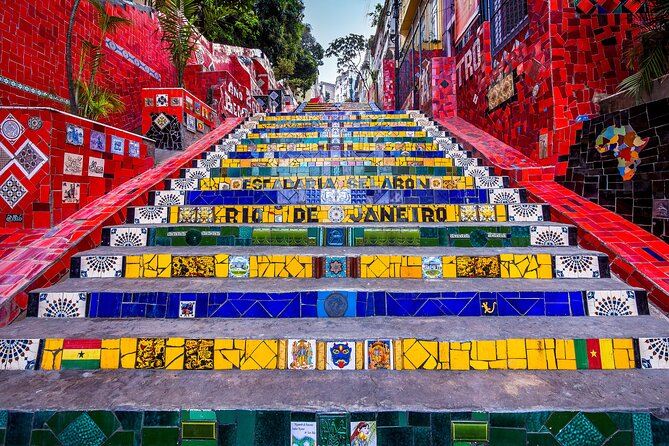
After the big monument, you shift to something human-sized: the Escadaria Selarón between Santa Teresa and Lapa. This staircase isn’t just pretty. It’s an artwork project made by Chilean artist Jorge Selarón, built as a long-running tribute to the Brazilian people.
You’ll spend around 20 minutes here, and admission is free. That short visit is actually right for this stop. The staircase is visual, and you’ll get a lot of it quickly: tile colors, the mix of patterns, and the sense of what the artist was trying to say through everyday materials.
This is also where you start to feel the tour’s theme: Rio isn’t only monuments. It’s also creativity in public space.
The only consideration is comfort. Even with a time limit, the staircase is a staircase—so plan for some uneven footing and take your time if you’re moving carefully.
Beaches from the vehicle: seaside mood without the time sink
Between the landmarks, you’ll also discover the beaches of Rio in a comfortable vehicle. The benefit here is simple: you get the “Rio is on the water” feeling without losing hours in slow-moving traffic or hopping between distant viewpoints.
What you won’t get from this approach is depth. You’re not going to cover every beach neighborhood on foot, and you likely won’t have a long stretch of beach time. But for a first visit—especially when you only have about five hours—this kind of drive-by “get the geography” stop is smart.
Think of it as a way to connect the city icons you’ll see later with the coast that shapes them.
Sambadrome da Marques de Sapucaí: Carnival culture, even on non-Carnival days

Next is the Sambodromo da Marques de Sapucaí (also known as Passarela Professor Darcy Ribeiro). It’s where the most famous popular festival in Brazil happens: the annual parade of samba schools during Carnival.
You’ll have about 20 minutes here, with entry marked as free. The tour context makes a difference. On a non-Carnival day, the Sambadrome can feel like a football field with architecture. But if you’ve got even a little interest in why Carnival matters in Rio, this is the place where you can see the scale of the spectacle built into the city.
Practical note: this stop is quick, so don’t expect a deep guide-style explanation of every technical detail. Use the time to walk, look at the setting, and connect it to what you’ve seen on TV or in photos.






Metropolitan Cathedral: modern lines, stained glass, big room
Then comes a curveball from Carnival: Catedral Presbiteriana do Rio de Janeiro (often referred to as the Metropolitan Cathedral of Rio). It’s a Catholic cathedral with a modern conical design, inaugurated in 1979, and it’s designed for a capacity of 20,000 people standing.
You get about 30 minutes, and admission is marked as free. What to focus on: the geometry and the light. The building’s straight, sober lines are the framework; the colored stained glass up toward the dome is what turns it into an experience.
This is one of those stops that works well inside a tight tour because you don’t need hours to notice what makes it special. You’ll feel the “big space” quickly, then you’re ready for the next shift.
Floresta da Tijuca: an urban forest with a reforestation origin
Rio’s green side isn’t just parks you can wander slowly. You’ll visit Floresta da Tijuca, one of the largest urban forests in the world. It was created in 1861 by Emperor Pedro II as reforestation after deforestation from sugarcane and coffee cultivation.
You’ll have about 10 minutes, and admission is marked as free. That’s not enough time for a full hike, but it’s enough time to register the contrast: you’re leaving concrete and icons and stepping into a forested pocket that has a clear story behind it.
The value of a short stop like this is perspective. Even briefly, it helps you understand why Rio feels different from many other big cities. You’re not only seeing Rio’s monuments; you’re seeing its planning—and its scars—written into the environment.
Maracanã: football in one stop
The last landmark stop is Maracanã (Estádio Jornalista Mário Filho). It’s one of Brazil’s best-known stadiums, located in Rio’s North Zone.
You’ll spend about 20 minutes, with admission marked as free. The tour doesn’t turn this into a “stadium tour” experience with long corridors and deep history (at least not within the time window). Instead, it’s a quick hit so you can place the stadium in the bigger Rio picture: football isn’t a side hobby here. It’s part of local identity.
If you care about the sport, this is the kind of stop that gives you context even if you don’t go into every detail.
Price and value: what $90 buys you (and what it doesn’t)
At $90 per person for about 5 hours, this isn’t an economy “drive-by” tour. The value comes from stacking multiple major Rio sights into one morning with free-entry notes at several stops.
That said, you are buying a schedule, not freedom. You’ll have fixed time blocks—about an hour at Cristo and shorter windows for everything else. If you want more time to wander at any single stop, this format may feel limiting.
Group size also affects value. With a maximum of 19 travelers, you’re less likely to lose your entire day to bottlenecks that happen in huge groups. Still, timing matters, and you can feel it if people move slowly at a stop.
One more value angle: weather. Because the experience requires good weather, it can either deliver the views (especially at Corcovado) or get adjusted. That risk is part of pricing decisions, even if the tour’s plan keeps moving.
Guides, language, and how to get the most from the experience
Your guide can shape the day. In accounts tied to this operator, Márcio is described as very informative and able to explain local culture with depth. At the same time, there’s also a cautionary story about a guide being strict or sharp when someone was late and crowds made timing tighter.
So here’s the practical takeaway: treat the meeting time seriously. Give yourself a buffer so you don’t start the day stressed. The tour runs on a sequence, and Cristo’s crowd energy leaves little slack.
Language can also vary. Some visitors report receiving explanations in Spanish and Portuguese. If you need English specifically, you should confirm what’s available for your date when you book.
If you do that, you’ll get more out of each stop than just photos—you’ll understand why these places matter in the way Rio tells its story.
Who should book this tour
Book this if:
- You want a first-time Rio morning that hits the biggest icons without spending the whole day on logistics
- You like seeing different sides of the city in one pass: monuments, street art, religious architecture, football, and a major Carnival venue
- You prefer a small group over a big bus crowd
- You’re okay with short time windows because you’re getting a lot of variety
Skip it if:
- You want long wandering and deep museum-level time at one single site
- Your schedule is fragile and you can’t risk strict timing
Should you book this Rio Icons tour?
I’d book it if you’re visiting Rio for the first time and want the “greatest hits” without building a plan from scratch. The combination makes sense: Corcovado sets the city scale, Selarón Staircase gives you texture and creativity, and the later stops show Rio’s identity beyond the skyline—Carnival culture, religious architecture, a reforested urban forest, and football at Maracanã.
Just go in with the right expectations. It’s about coverage, not lingering. If you’re punctual and you’re excited by variety, this is a solid use of a morning at a fair price.
FAQ
What time does the tour start?
The tour starts at 8:00am.
How long is the tour?
It runs for about 5 hours.
How much does it cost?
The price is $90.00 per person.
How many people are in a group?
The group size has a maximum of 19 travelers.
Are the attraction tickets included?
The tour notes admission ticket is free for the listed stops, including Christ the Redeemer (Corcovado), the Selarón Staircase, the Sambadrome, the cathedral, Floresta da Tijuca, and Maracanã.
What happens if the weather is bad?
This experience requires good weather. If it’s canceled due to poor weather, you’ll be offered a different date or a full refund.
Can I cancel for free?
Yes. You can cancel up to 24 hours in advance for a full refund.