REVIEW · RIO DE JANEIRO
Rio Downtown Tour with Selaron Metropolitan Cathedral and more
Book on Viator →Operated by Carioca Tropical Tour Operator · Bookable on Viator
Rio downtown packs a lot into three hours. I like the small-group setup because it makes those quick stops feel less like cattle-car sightseeing. You also get the Escadaria Selarón and the big cathedral in the same afternoon, so you see two sides of Rio: sacred and street.
One drawback to keep in mind: this is a fast loop through central neighborhoods, and time per stop can be tight if traffic runs slow. Expect short visits, not long, sit-down museum-style wandering.
In This Review
- Key highlights worth planning for
- The three-hour idea: downtown Rio, tightly packed
- Pickup, timing, and why you should dress for the schedule
- São Bento Monastery: an active abbey in the middle of the city
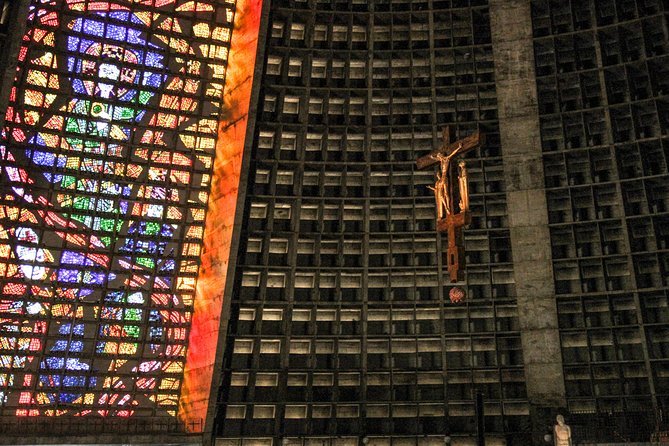
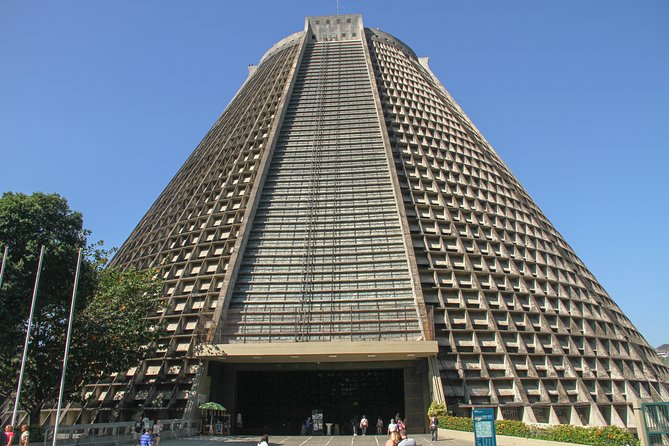
- Metropolitan Cathedral: Mayan-like shape, serious sound
- Downtown monuments along Avenida Presidente Vargas
- Maracanã stop: quick photos outside, not stadium time
- Lapa arches and Rua do Lavradio: classic Rio street life
- Escadaria Selarón: a one-person art project turned international landmark
- Flamengo and Aterro do Flamengo: waterfront views without the crowds
- Fort Copacabana and the Copacabana anchor points
- Guides make or break it: names I saw in the tour experience
- Price and value: does $74.50 make sense for what you see?
- Who should book this downtown loop?
- Should you book it?
- FAQ
- FAQ
- How long is the Rio downtown tour?
- What is the start time, and where does it begin?
- Where does pickup happen?
- How much does the tour cost?
- Which attractions are included?
- Are tickets and admissions included?
- What group size should I expect?
- Can I cancel for free?
- Do you offer anything for young children?
Key highlights worth planning for
- Hotel-area pickup in Zona Sul (Copacabana/Ipanema/Leblon) so you can start without wrestling transit first
- São Bento Monastery is an active Benedictine abbey, with a 30-minute stop and admission included
- Metropolitan Cathedral uses a striking conical design and tall stained glass windows that form a cross
- Lapa + Selarón Steps: world-famous tile artwork by Jorge Selarón, plus the tram-linked Arcos da Lapa
- Aterro do Flamengo: a reclaimed waterfront park ride with major sights like the WWII memorial and the Museum of Modern Art
- Max 19 travelers keeps the vibe manageable for photos and questions
The three-hour idea: downtown Rio, tightly packed
This tour is built for people who want a downtown orientation fast—the kind of afternoon where you see a lot of major landmarks without spending your day stuck in lines. It runs about 3 hours, starting at 1:30 pm, with a pickup/drop-off setup aimed at visitors staying in Copacabana, Ipanema, or Leblon.
You’re not doing a slow “neighborhood per half-day” plan. Instead, you move along Avenida Presidente Vargas, cut across central sights, then swing through Lapa for the arches and Selarón Steps. The finale cruises down Aterro do Flamengo, where you get a long stretch of waterfront views.
You can also read our reviews of more tours and experiences in Rio de Janeiro.



Pickup, timing, and why you should dress for the schedule
The tour starts with pickup from selected Zona Sul hotels in Copacabana, Ipanema, or Leblon. If you’re the type who likes to plan down to the minute, note the listed start location is the Hilton Rio de Janeiro Copacabana address on Av. Atlântica. Your end point is back at the meeting point.
Because this route is tight, you’ll want to dress for walking that’s quick, stop-and-go, and mostly outdoors. Sunglasses help. Also, think about footwear that can handle uneven sidewalks near Lapa and Selarón.
If you’re sensitive to schedule changes, remember Rio traffic can reshape the day. One negative experience in the mix wasn’t about the sights—it was about how long the van was late and how short some stops felt. So I’d treat “about 3 hours” as real-life, not brochure-life.
São Bento Monastery: an active abbey in the middle of the city
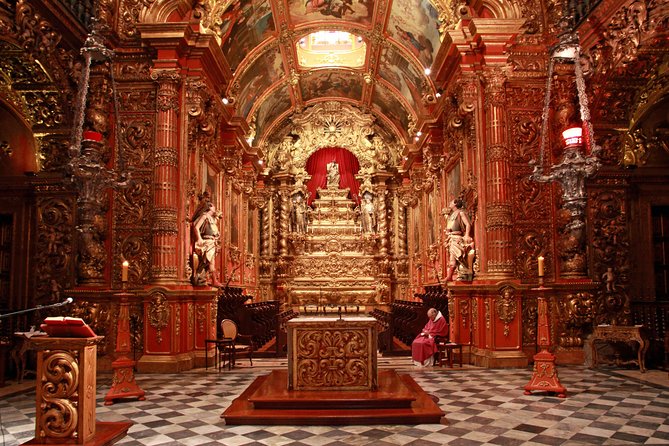
Your first major stop is Mosteiro de São Bento (Monastery of St. Benedict). This isn’t a dead monument. It’s still operational, with Benedictine monks who arrived in 1590 from Bahia. Nearby there’s also a St. Benedict College, so the area has a lived-in, working feel rather than just tourist “photo backdrop” energy.
What I like about this stop is the combo of story and visuals. The façade ties back to the original Mannerist project, with a centralized entrance and a triangular gable. There are three archways at the entrance, plus two towers topped with pyramidal spires. Inside the entry, you see a tiled porch and 19th-century iron gates.
You’ll get about 30 minutes here, with admission included. That’s enough time to slow down and actually notice the design, not just snap a quick picture and move on.
Metropolitan Cathedral: Mayan-like shape, serious sound
Next up is the Metropolitan Cathedral of Saint Sebastian. It’s known for architecture inspired by Mayan pyramids of Mexico, with a conical shape designed to suggest closeness to God. Even if you’re not a church architecture person, it’s hard not to be impressed by how bold the form is.
The tour’s description also calls out a detail that matters when you’re inside: four stained glass windows run from floor to ceiling, and they align to form a cross at the top. It also says the acoustics are excellent—almost the kind of place where even simple sound feels amplified.
You’ll spend about 30 minutes, and admission is free. The benefit of including this stop on a time-boxed tour is that you get a “wait, this is actually striking” moment before you move back into traffic-and-photo mode.
Downtown monuments along Avenida Presidente Vargas
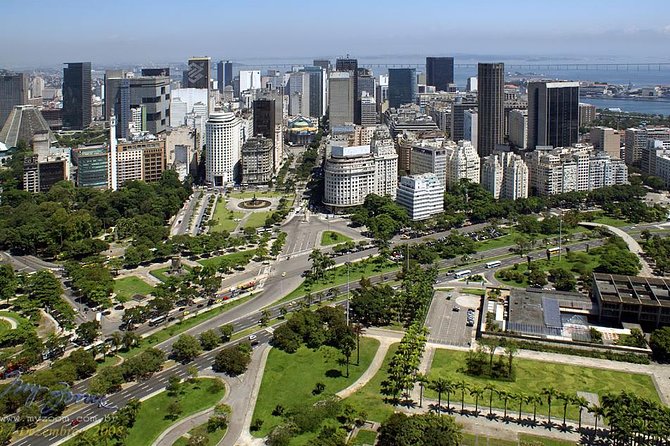
After the cathedral, the route keeps rolling through central Rio. You’ll pass by a lineup of heavyweight landmarks along and near Avenida Presidente Vargas, including the Central Railway Station, Duque de Caxias Palace, and Itamaraty Palace.
You’ll also get views of places like Campo de Santana and Tiradentes Square, plus the route along Avenida Chile. Even when you’re seeing them from the vehicle, this is valuable because downtown Rio can feel confusing on your own. A good guide-driven drive helps you place what you’re looking at, so when you come back later, it makes more sense.
If your guide is strong, this section is where you’ll get the “why this matters” context—how these government and rail-era buildings connect to the city’s story.




Maracanã stop: quick photos outside, not stadium time
Maracanã Stadium is a headline even if you’re not a soccer fan. It opened in 1950 for the World Cup and is listed as Brazil’s biggest stadium, with a capacity over 78,000.
Important detail: you do not go inside. The stop is about 15 minutes, with a quick exterior look at a spot near Bellini’s statue for pictures. The tour frames the stadium as a stage for major sporting and large musical events, but you won’t be spending time on the field or touring facilities.
I like this approach for a half-day loop. You still get the “I’m in Rio” moment without sacrificing time you might want for Selarón Steps.
Lapa arches and Rua do Lavradio: classic Rio street life
From central Rio, you head into Lapa, where the mood shifts. This is where the tour gets more photogenic and more character-heavy, and where it’s worth slowing down your walking pace.
You’ll see the Carioca Aqueduct, commonly called Arcos da Lapa. The description notes that since the end of the 19th century, the aqueduct has served as a bridge for a popular tram that connects the city center to Santa Teresa uphill. That detail makes the aqueduct feel more than decorative—it’s part of how the city moves.
Then there’s Rua do Lavradio. This is known for antique shops, bars, and restaurants that keep the street lively. The tour info also notes that on the first weekend of each month there’s a street fair with both national and foreign tourists and locals.
Time is about 20 minutes there. On a day like this, it’s enough to get a feel for the neighborhood energy and grab a few photos, but not enough to treat Rua do Lavradio like your personal evening plan.
Escadaria Selarón: a one-person art project turned international landmark
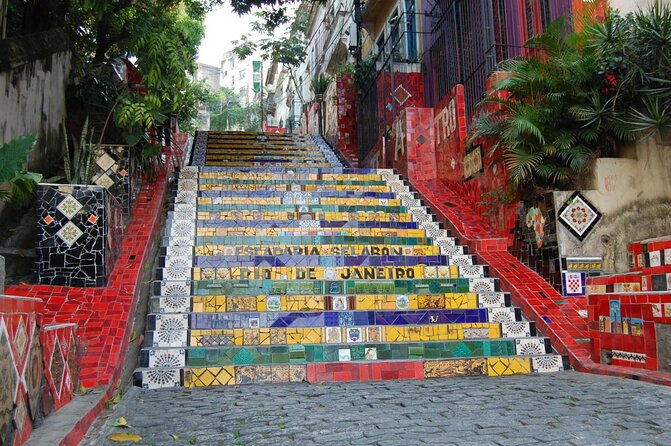
This is the emotional center of the tour, and it’s easy to see why. Escadaria Selarón (Selarón Steps) is a set of steps that became world-famous through the work of Chilean-born artist Jorge Selarón.
The story goes like this: in 1990, Selarón began renovating dilapidated steps in front of his house. Neighbors mocked his choice of colors at first, because he covered the steps with tile fragments in blue, green, and yellow—the colors of the Brazilian flag. It started as a side project to painting, but then became an obsession. He sold paintings to keep funding the work, and the process was long and exhausting until he covered the entire set with tiles, ceramics, and mirrors.
You’ll spend about 30 minutes, and entry is free. If you want the best photos, aim to pause where the color is most intense and where you can frame the steps up toward the buildings. Also, don’t just look at the tiles. Look at how the colors lead your eye upward—Selarón clearly built it like a visual staircase.
Flamengo and Aterro do Flamengo: waterfront views without the crowds
After Lapa, the tour cruises down Aterro do Flamengo, a huge waterfront park built on reclaimed land—nearly 300 acres (about 1.2 km²)—and completed in 1965. The landscape design is credited to Roberto Burle Marx, which matters because the park isn’t just concrete and view points. It’s a planned green space.
Along the way, you’ll pass by major landmarks like:
- Church of the Outeiro da Glória
- Monument to the Fallen in World War II
- Museum of Modern Art
This is a nice change of pace after the stairs and arches. You’re not doing a deep walk here; you’re seeing a stretch of Rio’s coastline feel, and that can help you decide what you want to revisit later.
Fort Copacabana and the Copacabana anchor points
The tour also includes a stop related to Fort Copacabana, a military base at the south end of the beach that defines the district. The description says the base is open to the public, and it includes the Army Historical Museum plus a coastal defense fort.
Even though your afternoon is mostly about central Rio, including Fort Copacabana gives you a more complete Rio picture—military history and coastal defense next to the city’s more famous party and beach identity.
Guides make or break it: names I saw in the tour experience
This kind of fast, multi-stop day depends on the guide’s pacing. The good news: the tour has a strong track record, with a 4.8 rating and 94% recommended.
I’ve seen specific guide names connected to smooth, engaging tours—Monica and Victoria stood out in how they handled the route and kept it lively. There were also notes about Arthur and Andre working well as a team, and Sabina plus driver Ricardo making sure the time got used to see everything described. In another case, Vincent Thomas was credited for strong English and tailoring the experience.
Bottom line: if your guide is active, you’ll get more than sightseeing. You’ll get a sense of where you are and why these buildings and neighborhoods matter.
Price and value: does $74.50 make sense for what you see?
At $74.50 per person for about 3 hours, the price feels reasonable for a few reasons.
First, you’re paying for the convenience of moving efficiently across downtown, plus air-conditioned minivan transport and a professional guide. In a city like Rio, that saves time you’d otherwise spend sorting out transit and dealing with the logistics of multiple locations in one afternoon.
Second, there are real inclusions. São Bento Monastery admission is included, while other key sights are explicitly free (like the Metropolitan Cathedral and Selarón Steps). Maracanã’s stop is quick and doesn’t include admission, which matches how the tour is structured.
Finally, the group limit—maximum 19 travelers—helps keep it from feeling chaotic. If you’re traveling solo or you just want your questions answered without waiting, that’s a tangible value.
If you’re the type who loves lingering, you might find the time at each stop a bit short. But for a first-week-in-Rio snapshot, it’s a solid deal.
Who should book this downtown loop?
Book this tour if you want:
- A first or second day orientation to Rio’s central districts
- A mix of landmark architecture (cathedral, monastery) plus street-art energy (Selarón Steps)
- A quick hit of sights you can later build around on your own
Skip it if you hate tight schedules. If your travel style is slow and deep—long museum hours, long guided explanations, lots of sitting—then you’ll likely want a different kind of tour.
It’s also a good match if you’re staying in Zona Sul and want pickup without dealing with buses, vans, or timing on your own.
Should you book it?
Yes, I’d generally recommend booking this one if you have limited time and you want a clean overview of downtown Rio plus the key Lapa and Flamengo sights. The route is logical for a half-day, the major stops are memorable, and the included/free admissions make the price feel more fair than a “pay for everything” tour.
Just go in with the right mindset: this is a sprint, not a marathon. Wear comfortable shoes, bring a camera you can move fast with, and use the guide’s explanations to decide what you want to revisit later.
FAQ
FAQ
How long is the Rio downtown tour?
The tour lasts about 3 hours.
What is the start time, and where does it begin?
The start time is 1:30 pm. The listed starting point is Hilton Rio de Janeiro Copacabana on Av. Atlântica, 1020 in Copacabana, Rio de Janeiro.
Where does pickup happen?
Pickup is listed for hotels in Zona Sul, including Copacabana, Ipanema, and Leblon.
How much does the tour cost?
The price is $74.50 per person.
Which attractions are included?
The tour includes stops such as Mosteiro de São Bento, the Metropolitan Cathedral of Saint Sebastian, Maracanã (outside for photos), Escadaria Selarón, São Bento Monastery area sights, Arcos da Lapa (Carioca Aqueduct), Rua do Lavradio, and scenic cruising along Aterro do Flamengo with sights including the Church of the Outeiro da Glória, the WWII monument, and the Museum of Modern Art.
Are tickets and admissions included?
São Bento Monastery admission is included. The Metropolitan Cathedral and Escadaria Selarón are listed as free. Maracanã is not included. Rua do Lavradio is listed as free.
What group size should I expect?
The maximum number of travelers is 19.
Can I cancel for free?
Yes. You can cancel for a full refund up to 24 hours in advance of the experience start time.
Do you offer anything for young children?
Children up to 5 years old with ID and on the lap are free.