
REVIEW · RIO DE JANEIRO
Rio in Style: A Journey Thru Corcovado, Sugarloaf, Selaron
Book on Viator →Operated by Guided Tour In Rio · Bookable on Viator
Rio can be a blur. This tour strings together the city’s must-sees in one tight route, with a guide keeping you oriented from Copacabana onward. I like that it’s built for getting your bearings fast: beaches, viewpoints, downtown landmarks, and a couple of bonus stops for weather and timing.
What I really liked are two things. First, the early timing means Christ the Redeemer and Sugar Loaf are tackled before the biggest crush, so you’re not stuck in slow lines for hours. Second, your guide handles the flow and context—explaining what you’re seeing while also planning around real-life Rio problems like traffic and cloud cover.
One consideration: a lot of the headline sights require separate payments on site. You’ll budget extra for Corcovado and Sugar Loaf, and lunch is on you even though the guide will point you toward solid options.
In This Review
- Key highlights worth factoring in
- Getting Your Bearings: A 7:00 am Route That Makes Sense
- Copacabana and the Ipanema Stretch: Beaches as a Neighborhood Map
- Morro da Urca and Sugar Loaf: The Views Are Worth the Separate Ticket
- Downtown Stops: The Imperial-Era Palace and Arcos da Lapa
- Selarón Steps: Tile Art You Can Walk Through
- Metropolitan Cathedral of Saint Sebastian: A Shape Made for Sound
- Tijuca Forest to Corcovado: The National Park Ride-Up and the Cloud Plan
- Mosteiro de São Bento and the Carnival-Era Rio: Faith, Gold, and Stadium Energy
- Lunch Time: Not Included, But the Guide Helps You Eat Like a Person
- Price and Ticket Budget: What You’re Really Paying For
- Who This Tour Fits Best (and Who Should Skip)
- Should You Book Rio in Style?
- FAQ
- What time does the tour start?
- Where is the meeting point?
- Are the Corcovado and Sugar Loaf entrances included?
- Is lunch included in the price?
- What happens if Corcovado is obscured by clouds?
- How large is the group?
Key highlights worth factoring in
- Early start at 7:00 am to hit top viewpoints before major lines
- Small group cap (14 travelers) helps you stay together and ask questions
- Weather backup at Corcovado: Mirante Dona Marta replaces the summit if visibility is bad
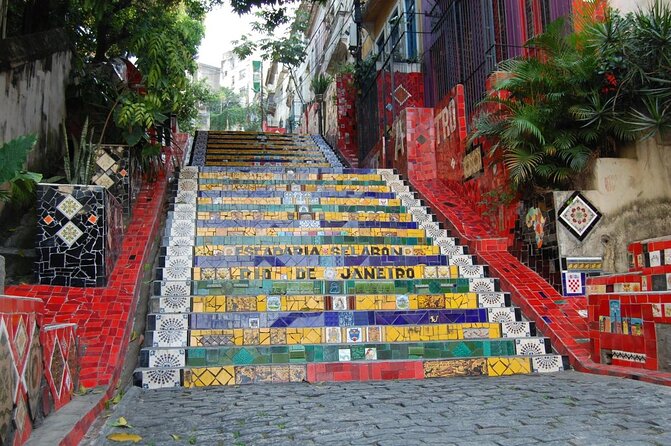
- Selarón Steps: 215 tiled steps by Jorge Selarón, built from tiles collected worldwide
- Most major downtown stops are free (Selarón, Metropolitan Cathedral, and the monastery)
- A guide who plans for logistics, not just photo ops
Getting Your Bearings: A 7:00 am Route That Makes Sense

This is the kind of day trip you’ll be grateful for on your first few days in Rio. The start time is 7:00 am, which matters more than it sounds. Rio’s top sights can spike fast with crowds, and early morning turns a painful wait into a manageable one. Add in the fact that you’re on an air-conditioned minivan and you’re not bouncing between stops like a pinball.
What you get is a full day of classic Rio scenes, but with structure: beaches in the south zone, viewpoints with big skyline payoff, and then the older, central neighborhoods where you see the city’s layout shift. Instead of spending half your time figuring out routes, you’ll spend that energy looking up.
The other smart part: your guide doesn’t treat the day like a checklist. They’re prepared for what Rio throws at you—especially clouds over Corcovado. That matters because the statue views are the whole point, and in bad visibility your day can either feel ruined or saved.
You can also read our reviews of more tours and experiences in Rio de Janeiro.



Copacabana and the Ipanema Stretch: Beaches as a Neighborhood Map
The tour begins at Hilton Rio de Janeiro Copacabana, then works the coast. You’ll start from Copacabana Beach, then swing through the Ipanema area—bounded by Arpoador Beach on one end and Leblon on the other.
This isn’t a long beach hangout. It’s more like a moving city lesson: you’ll see where the action concentrates and how Rio’s wealth and beach culture stack up along the coastline. Ipanema is described as one of the main centers of activity, and you’ll notice how the neighborhood identity shows up in the vibe and the real estate level.
If you’re the type who wants a quick orientation before you go exploring on your own, this segment is useful. It helps you understand which areas feel like Rio’s social engine—and which spots are better for wandering later.
Morro da Urca and Sugar Loaf: The Views Are Worth the Separate Ticket
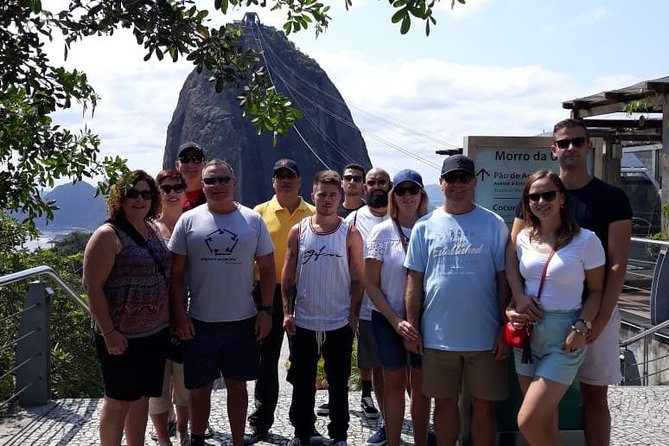
Morro da Urca is your first viewpoint. It’s a relatively small hill—220 meters—but it’s the launchpad for the cable car system heading toward Sugar Loaf. From the top, you can scan a huge slice of the city: beaches like Botafogo and Flamengo, the Cristo Redentor area, Guanabara Bay, downtown, and even distant landforms like the Serra do Mar and the peak known as Dedo de Deus.
Then you head up Sugar Loaf Mountain (about 396 meters). This is the moment many people come for: the sweeping skyline view that makes Rio feel like a planned stage set—water, hills, neighborhoods, and bridges all stacked together.
Here’s the practical reality. The tour price doesn’t include viewpoint admission. Corcovado and Sugar Loaf have separate entrance fees, and Sugar Loaf is specifically listed at $35 per person. So even though the experience feels smooth, you still need to budget for the cable-car ticket costs. I recommend you plan to pay at the site without expecting it to be covered by the base price.
The good news: the guide’s job here is keeping you on time for photo moments, not slowing you down for logistics.
Downtown Stops: The Imperial-Era Palace and Arcos da Lapa
After the viewpoints, the day shifts from high drama to city arteries. You’ll pass through central areas and see landmark architecture in a way that’s easier than trying to thread these points together yourself.
One stop is an important neoclassical palace. It was built around 1853 for merchant Machado Coelho, then acquired by the imperial government in 1865 for Princess Isabel and the Count of Eu. The building later went through changes, including a restoration in 1908, and since 1960 it belongs to the government of the state of Rio. Even if you’re not a museum person, it’s a quick history hit that helps explain why parts of downtown feel so formal.
Then comes one of Rio’s most photogenic shapes: the Carioca Aqueduct, also called Arcos da Lapa. It’s in Lapa and has served since the late 19th century as a bridge for a tram route connecting the city center with Santa Teresa. It’s a perfect stop for people who want the city’s engineering and street life to show up in the same frame.
If you’re hoping for a long sit-down at each downtown landmark, this isn’t that kind of tour. But if you want a guided route that keeps you from getting lost and missing things, this part does the job.
Selarón Steps: Tile Art You Can Walk Through

If you only remember one artistic stop, make it the Escadaria Selarón (Selarón Steps). This tiled stairway connects areas of Lapa and Santa Teresa, and it was created by self-taught Chilean artist Jorge Selarón.
The scale is what grabs you first: 215 steps fully covered with tiles. Selarón chose a palette tied to the Brazilian flag—green, yellow, and blue—and the tiles weren’t all bought in a neat bundle. They were collected from around Rio’s urban areas and also donated by visitors from all over the world. Since 1990, it has grown with over 2,000 tiles, which is why the steps feel personal even when you’re just visiting.
This stop is also free, which makes it a great use of time. You’ll likely want a few extra minutes to look closely at the tile mix and the different textures and colors. One detail I found especially fun: the steps have appeared in music videos, including Beautiful by Snoop Dog and Pharrell Williams (2002).
If you like street art with a story—less museum and more living collage—this is the moment.




Metropolitan Cathedral of Saint Sebastian: A Shape Made for Sound
Next you’ll visit the Metropolitan Cathedral of Saint Sebastian—a cone-shaped modern landmark with architecture inspired by Mayan pyramids. The conical shape is said to bring a sense of closeness to God, and you’ll see four stained glass windows that run floor-to-ceiling and form a cross at the top.
This stop is free, and it’s a nice break from all the hill-watching and stairs. The cathedral’s design is also described as having excellent acoustics, so if you catch even a small moment of sound inside, it feels like the building is designed for it.
The route here often includes passing through streets like Lavradio and Avenida Chile, and you’ll see how the city changes as you move away from the aquarium of viewpoints and toward the working heart of Rio.
Tijuca Forest to Corcovado: The National Park Ride-Up and the Cloud Plan
This is where the day tilts into nature and big views. The tour reaches Tijuca Forest, described as a tropical rainforest inside the city, and it notes the stop at Paineiras.
At Paineiras, you board official vehicles operated by the National Park authority to get up toward Corcovado where Christ the Redeemer stands. That park-vehicle step matters because it’s part of how Rio protects access while still letting visitors reach the summit area.
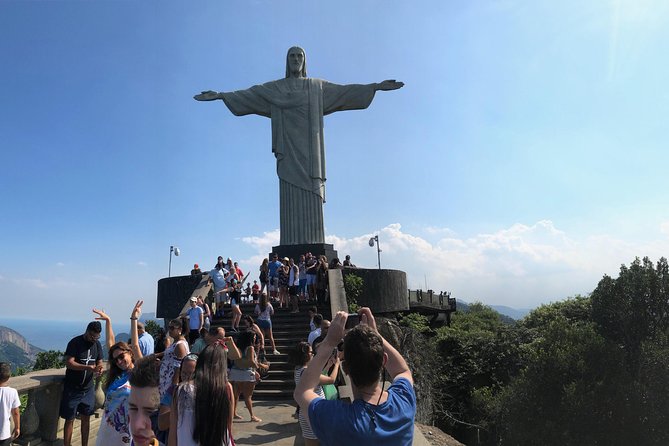
Then you get to Corcovado. The statue, made of reinforced concrete and covered with thousands of triangular soapstone tiles, is 38 meters tall. The view from the top is the whole point, but it’s weather-dependent. If cloud cover blocks the summit, the tour doesn’t just shrug.
Instead, there’s a backup: Mirante Dona Marta. This viewpoint is listed at 362 meters, and it’s generally less affected by cloudiness. Mirante Dona Marta is also free, and it’s meant to keep your day from collapsing when the main plan can’t deliver.
I like this approach. It’s not a guarantee of sunshine, but it is a guarantee that you won’t be stranded staring at mist with nothing else planned.
Mosteiro de São Bento and the Carnival-Era Rio: Faith, Gold, and Stadium Energy
After the views, you’ll switch gears again. The tour includes Mosteiro de São Bento, described as the oldest monastery in Rio, featuring the Golden Church. It’s a quick, atmospheric stop that adds a cultural layer without turning the day into a lecture.
Then you move toward large-scale Rio symbols: a world-famous stadium setting and the Carnival parade venue. The tour data points to Maracanã (world-famous stadium) and a Carnival parade stadium (often associated with the big samba processional stage).
This part works best if you’re curious about how Rio organizes spectacle—how sports and Carnival infrastructure are as much part of the city’s identity as beaches and viewpoints. You won’t get a deep dive into events on a standard visit day, but you’ll at least understand the scale and where these things live in the urban grid.
Lunch Time: Not Included, But the Guide Helps You Eat Like a Person
Lunch is not included. You’ll have time to eat, and your guide will point you toward restaurant options.
In real-world terms, this matters because Rio has plenty of places that look tempting but aren’t always the best value once you account for service and pricing. A solid guide tip can save you money and time. Some guides on this route have arranged meals in Ipanema-style settings, including Brazilian barbecue-style steakhouses, where the experience can be very filling for the price you pay.
The bottom line: treat lunch as your flexible budget line. Plan for it, then let the guide steer you toward a spot that matches what you want that day: quick and simple, or sit-down and try something local.
Price and Ticket Budget: What You’re Really Paying For
The base price is $97 per person for about 8 hours. You also get professional guiding, air-conditioned minivan transport, and hotel pickup/drop-off for selected hotels.
But don’t ignore the ticket math. Corcovado has an admission fee listed at $20 per person, and Sugar Loaf is listed at $35 per person. So right away, plan for roughly $152 total before lunch, assuming you pay the listed viewpoint entrances.
What makes this good value is that the base price buys you time-saving structure:
- you’re not dealing with separate transport timing between far-apart stops
- you’re guided through what you’re seeing and when to look for the best photo windows
- you get a Corcovado visibility backup, not just a single bet
If you’re traveling alone and trying to stitch together equivalent viewpoints via public transport, you’ll spend time and likely lose some of the early-day advantage. If you’re traveling with a partner or a small group, the cost starts to feel more reasonable because you’re paying to remove stress.
Who This Tour Fits Best (and Who Should Skip)
This fits best if you want a first-day overview of Rio without turning your holiday into a transit project. It’s also ideal if you like small group touring—the cap of 14 travelers keeps it from feeling like a cattle pen, and guides have room to manage the group.
You might want to skip or choose something else if you:
- hate paying separate admissions and would rather build a free, self-paced itinerary
- want a deep museum-style experience with long indoor time
- dislike long days where sightseeing is packed from early morning to afternoon
If you’re worried about mobility, the tour notes that most travelers can participate, and in at least one real experience on this route the team helped make the day work for a guest with mobility needs. Still, if mobility is a big concern for you, ask questions before booking so you can confirm which steps and transfers will be manageable.
Should You Book Rio in Style?
I think you should book this if your priority is seeing Rio’s greatest hits in one day with a guide-run plan, not if you’re trying to minimize costs at any price. The early start is the star. The viewpoints are the payoff. And the cloud backup at Corcovado is a smart move that turns a “maybe” day into a “let’s work the problem” day.
If you’re on your first Rio visit and you want the big picture—Corcovado, Sugar Loaf, Selarón Steps, and key central landmarks—this is a strong, practical choice.
FAQ
What time does the tour start?
The tour starts at 7:00 am.
Where is the meeting point?
The start point is Hilton Rio de Janeiro Copacabana, Av. Atlântica, 1020, Copacabana.
Are the Corcovado and Sugar Loaf entrances included?
No. Entrance fees are not included. Corcovado is listed at $20 per person and Sugar Loaf Mountain at $35 per person.
Is lunch included in the price?
No. Lunch is not included, though the guide will have time for you to eat and will show you restaurant options.
What happens if Corcovado is obscured by clouds?
The tour includes a backup stop at Mirante Dona Marta if visibility is poor on the Corcovado summit.
How large is the group?
The tour has a maximum of 14 travelers.