REVIEW · RIO DE JANEIRO
Jewish Tour in Rio de Janeiro
Book on Viator →Operated by Guided Tour In Rio · Bookable on Viator
Jewish Rio in just a few hours is the trick. You’ll get a small-group run through key neighborhoods and institutions, with guides like Ephraim or Leonardo explaining how different Jewish communities shaped the city. It’s also built to save you time: hotel and port pickup means less hunting around and more looking up at real places.
I like how the stops cover more than one style of Judaism, from Orthodox and Lubavitch to Progressive Judaism, instead of only repeating the same postcard facts. I also love the built-in “city orientation” feel—beach walks, viewpoints, and short transfers that help you understand where things sit in Rio’s big geography. One possible drawback: the time is tight, so you’ll see a lot of highlights but not everything, and access can vary (for example, the Grande Templo is not always open outside special dates).
In This Review
- Quick hits before you go
- Getting oriented in Rio with Jewish history as your guide
- From Copacabana’s Hilton to a 9:00 am start (and why timing matters)
- Leblon and Ipanema: Lubavitch synagogue life near the sea
- Botafogo Beach: Anne Frank education and Progressive Judaism at ARI
- Botafogo Bay viewpoint: Itzhak Rabin Park and the “state-to-state” story
- Museu Judaico do Rio: a small space with serious archives
- Grande Templo Israelita do Rio: the big monument, and why access can vary
- What $95 buys you (and whether it’s a fair value)
- Who should book this Jewish tour in Rio
- Should you book it
- FAQ
- How long is the Jewish Tour in Rio de Janeiro?
- How much does the tour cost?
- What is included in the price?
- What is not included?
- Where does the tour start, and when?
- Where does the tour end?
- How big is the group?
- Are children allowed?
- What is the cancellation policy?
Quick hits before you go
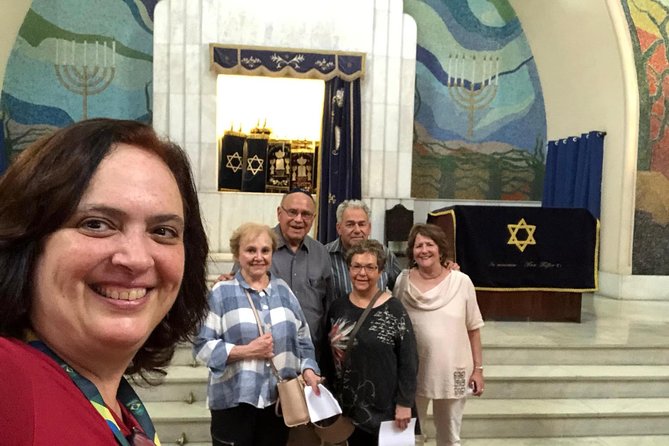
- Small group, max 14 people: questions stay easy and the guide can slow down when needed.
- Pickup that handles the hassle: selected hotel pickup plus port pickup if you’re arriving by cruise ship.
- Mix of Jewish communities: Lubavitch, Progressive Judaism (ARI), and Ashkenazi institutions show up in the same morning.
- Holocaust memory points: you’ll pass major reference sites like Anne Frank’s network school and Holocaust-focused spaces tied to community centers.
- Real city context: beaches and viewpoints (Leblon, Ipanema, Botafogo Bay) help the history stick.
- Museum stop is optional-fee: Museu Judaico is part of the route, but admission isn’t included.
Getting oriented in Rio with Jewish history as your guide
Rio is huge, and Jewish history here is scattered across neighborhoods rather than concentrated in one “district.” That’s exactly why this tour makes sense. You start with pickup and a driver, then move in a vehicle along the coast so you’re not spending your vacation zigzagging for cab rides.
The best part is the balance: you get outdoor time on the beaches and a viewpoint over Botafogo Bay, but the tour’s center of gravity stays on Jewish institutions and what they were built to do—community, continuity, education, and remembrance. And because the group is capped at 14, the guide can actually answer questions instead of rushing everything through like a drive-by slideshow.
If you’re the type who wants a “where did this come from and who built it” explanation, this works well. You’ll hear the story behind several places—why they exist, who they serve, and how Rio’s Jewish life developed across time.
You can also read our reviews of more tours and experiences in Rio de Janeiro.



From Copacabana’s Hilton to a 9:00 am start (and why timing matters)
The tour starts at 9:00 am at the Hilton Rio de Janeiro Copacabana (Av. Atlântica, 1020, Copacabana). It ends back at the meeting point. That structure is practical in Rio: you get your sights early, when the light is better for photos and before the midday heat fully arrives.
The pickup includes selected hotels and also supports port pickup, which is a big deal if you’re on a cruise and don’t want to burn time figuring out transportation. Just know that pickup logistics depend on the operator’s selected locations; you’ll want to confirm your exact pickup point at booking.
At about 3 hours total, you’re not touring at a leisurely museum pace. You’re doing an efficient circuit that’s designed to give you a strong first map of Jewish Rio—enough to decide what to explore more later on your own.
Leblon and Ipanema: Lubavitch synagogue life near the sea
Your first zone is Praia do Leblon, an area known for its upscale housing and high-end feel. Even if you’re not staying in Leblon, it’s useful to see it because you’ll understand how Jewish institutions sit inside Rio’s social geography—not only in a historical sense, but in a “where people lived and worshipped” sense.
This is where you’ll see the Beit Lubavitch Synagogue and the Midrash Cultural Center. The point here isn’t just architecture or a quick photo stop. It’s that “learning” shows up as a religious duty and a community function. A cultural center next to a synagogue tells you that education isn’t an optional extra; it’s part of the ecosystem.
From there, the route connects you to Ipanema, one of Rio’s most active beach stretches (with Arpoador at one end and Leblon at the other). This area matters for the tour because you’ll also encounter the CIB – Jewish Community Center. A community center at beach level signals a different kind of Judaism than a purely ritual-only view: it’s about programs, gatherings, and day-to-day communal life.
You’ll get the “Rio energy” here without it turning into a pure beach tour. The guide frames the setting so you can connect the dots between lifestyle, community space, and history.
Possible consideration: beach neighborhoods can be visually gorgeous but also busy. The tour time is short, so you’ll want to keep your schedule flexible inside the stops. If you’re hoping for long interior time at every site, the compact route may feel a bit fast.
Botafogo Beach: Anne Frank education and Progressive Judaism at ARI

Next you head toward Botafogo Beach, where the coastal views feel like a postcard—Rio’s hills and bays in one direction, ocean in the other. This stop works as a reset point: you see the city’s look and rhythm, then the tour pivots back to names and institutions tied to Jewish memory.
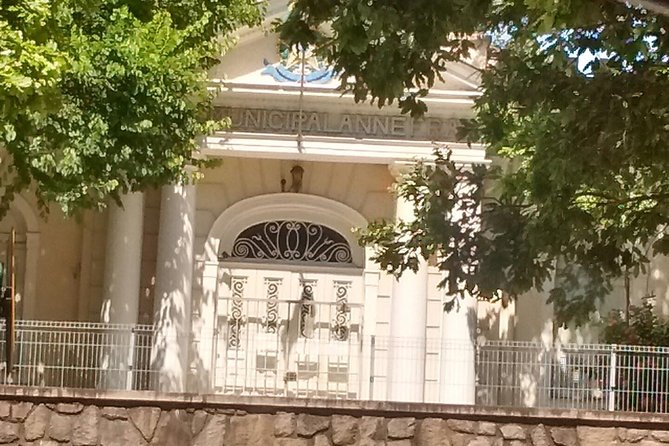
One of the strongest educational anchors here is a municipal school named after Anne Frank. The key detail is that it’s part of the Network of Schools Anne Frank associated with the CONIB and other partner organizations. In other words, the tour isn’t treating Anne Frank as a standalone memorial. It’s showing how that story is used as a values-based educational framework—peace, respect for diversity, and human rights.
Then you’ll have another important stop in the area: the A.R.I. Synagogue. This is tied to Israel’s Religious Association of Progressive Judaism in Rio and is affiliated with the World Union for Progressive Judaism (WUPJ). The operator also connects this community to a larger community infrastructure: the Rabbi Henry Lemle Community Center, which opened in 1997 and includes classrooms, a library, an auditorium, administrative offices, plus a synagogue space.
What I like about this part of the tour is that it shows how Progressive Judaism functions in Rio today. It’s not only about worship. It’s also about reference work and research—there’s a Holocaust reference and research component connected to the center, so the memory theme stays active rather than becoming a one-stop checkbox.
If you’re a first-time visitor to Jewish Rio, this section does a lot of the heavy lifting. It shows you that different streams of Judaism can build institutions with similar goals: community strength, education, and a link between past and present.
Botafogo Bay viewpoint: Itzhak Rabin Park and the “state-to-state” story
The tour moves to Botafogo Bay, stopping at Itzhak Rabin Park. This park is named for the former Israeli president, and it’s not just a scenic rest area. It also communicates symbolism: you’ll see a bust of Itzhak Rabin, and the park is described as representing the relationship of the Brazilian state with the state of Israel.
The geography here is part of the meaning. The park is located on top of Morro de Pasmado, and that elevated position gives you an accessible viewpoint. You get to see the bay of Botafogo and Urca Bay from above, which helps you “place” what you’ve been driving through.
I find viewpoint stops useful in a tour like this because they stop the story from becoming purely institutional. A city view makes the history feel real and physical. You’re not only hearing about organizations—you’re seeing the setting those organizations serve.
Possible drawback: viewpoint access can be weather-dependent. Also, the tour is only about 20 minutes at this stage, so plan for photos but don’t expect a long linger.




Museu Judaico do Rio: a small space with serious archives
Your next indoor stop is the Jewish Museum of Rio de Janeiro (Museu Judaico do Rio de Janeiro). This museum was founded in 1977, sparked by the donation of a menorah—described as a seven-branched candelabrum and a key symbol of Judaism. That origin story matters: it shows how Jewish memory can start with a single artifact and grow into a wider cultural mission.
The museum is described as a dynamic cultural center integrated into city life through programs. The goal is twofold: preserving memory and promoting Jewish culture across religious, cultural, and historical aspects. In practice, that means you’ll find exhibits tied to the community’s history in Rio and traditions.
What I’m glad this stop includes is the research and documentation angle. The museum includes a Study Center focused on migration and the Holocaust, a video archive with over a thousand films, and a library. If you want to understand Jewish life in Rio beyond worship spaces, this is where the story expands.
There is one practical note: admission tickets aren’t included in the tour price. The time allotment is about 30 minutes, so this isn’t an all-day museum visit. But it’s still a meaningful stop, especially if you’re curious about how migration narratives and community life get preserved.
Possible consideration: one review experience noted that a related Holocaust museum stop was closed on their visit. Since admission fees and opening hours can vary, I’d treat the museum portion as “planned,” not guaranteed at full capacity. If you have a must-see exhibit, you might want to check hours ahead of time once you have your travel dates.
Grande Templo Israelita do Rio: the big monument, and why access can vary
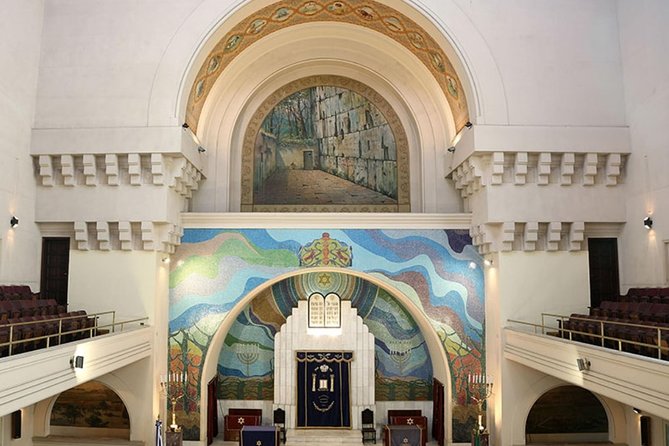
The final major stop is the Grande Templo Israelita do Rio de Janeiro, described as Ashkenazi and as the Jewish community’s largest monument tied to the history of the Yishuv and the city.
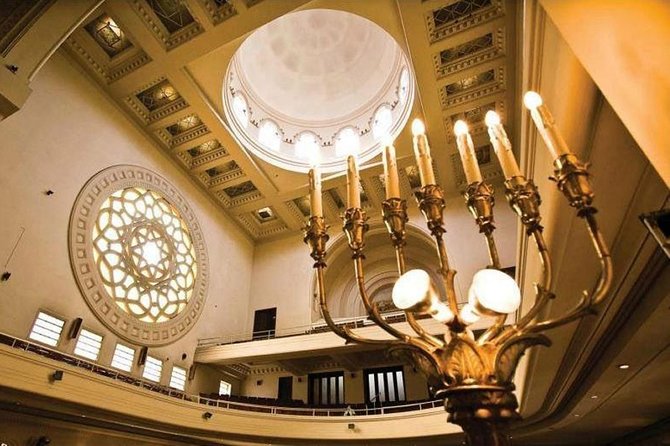
This is a place built to be seen. The temple has an eclectic style with elements of Hebrew origin and classical architecture. The design is credited to an architect named Vodred, worked out in 1919, and the temple opened in 1932. Mosaics were created in 1976 by artist Humberto Cozzo.
Here’s the big historical twist: it collapsed in 1987 and is now described as being open only during High Holidays, special events, and tourist visits. That means your experience may depend on timing and access rules.
In other words, don’t assume you’ll always have full interior access. You’re visiting the largest monument, but the tour may include viewing and explanation even if the building isn’t open the way a functioning synagogue would be.
I like this stop for what it represents: Jewish Rio isn’t just a set of small places. There’s a monumental piece of community identity here too—plus a story of resilience and changing access over time.
What $95 buys you (and whether it’s a fair value)
At $95 per person for about 3 hours, this tour is positioned as a value play, not a cheap one. It’s not trying to be a “free walking tour.” You’re paying for the guide, the vehicle, and the pickup/drop-off convenience.
Here’s what you’re getting that matters:
- Professional guide (with a group small enough for real Q&A)
- Hotel pickup and drop-off for selected hotels
- Port pickup and drop-off (handy for cruise days)
- Transport by car or van
- Multiple Jewish sites across different neighborhoods
The entrances are mixed. Some are listed as free (for example, the synagogue and cultural center time is marked as free in the route details, and several parks/areas note free admission). But the Jewish Museum and Grande Templo specifically note admission not included. Also, food isn’t included.
So is it worth it? For me, it hinges on whether you want the guide to connect the dots for you. If you’re comfortable self-planning and reading everything on your phone, you could piece together some stops. But the advantage here is the organization: Jewish sites spread across coastal neighborhoods, plus the education-focused explanations you wouldn’t easily get from signage.
Also, with a cap around 14 people, you’re paying to avoid the “big bus tour” feel. That personal attention is one of the strongest reasons this tour scores so well.
Who should book this Jewish tour in Rio
This tour is a strong match if you:
- Want a first introduction to Jewish history in Rio, without doing logistics
- Care about learning how different Jewish communities live and build institutions
- Like your sightseeing to include human stories and values-based memory (Anne Frank education and Holocaust-focused research spaces)
- Are short on time and still want a guided route through multiple neighborhoods
You might want to consider other options if:
- You need long interior time at every synagogue or museum. The schedule is compact.
- You’re expecting guaranteed full access to the Grande Templo building. Since it’s open only at certain times, it’s not something to count on.
Should you book it
I think this is a good booking when you want a guided, respectful, efficient “Jewish Rio” overview. The mix of beaches plus Jewish institutions gives you both context and culture, and the small-group size helps the guide keep things personal.
If you’re okay with a tight schedule and the fact that some places may have limited access, this tour gives you strong value for $95—especially because pickup and transport handle the hardest part of Rio touring. If Jewish history is on your must-do list, this is one of the most straightforward ways to see a meaningful slice of it in a single morning.
FAQ
How long is the Jewish Tour in Rio de Janeiro?
The tour lasts about 3 hours.
How much does the tour cost?
It costs $95.00 per person.
What is included in the price?
You get a professional guide, transport by vehicle (car or van), and hotel pickup and drop-off (selected hotels) plus port pickup and drop-off. Entrance tickets and food and drinks are not included.
What is not included?
Entrance tickets are not included. Food and drinks are also not included.
Where does the tour start, and when?
It starts at the Hilton Rio de Janeiro Copacabana at Av. Atlântica, 1020 – Copacabana, Rio de Janeiro, RJ, 22010-000, Brazil. The start time is 9:00 am.
Where does the tour end?
The activity ends back at the meeting point.
How big is the group?
The tour has a maximum of 14 travelers.
Are children allowed?
Children must be accompanied by an adult.
What is the cancellation policy?
You can cancel for a full refund up to 24 hours in advance. If you cancel less than 24 hours before the experience starts, you won’t receive a refund.